English to Japanese: Common Mistakes to Avoid and How to Sound Natural
Table of Contents
Translating from English to Japanese is full of pitfalls. Avoid these common mistakes to sound more like a native and less like a textbook.
Yumi Tanaka
Verified ExpertJapanese Language Specialist (JLPT N2) | Manga Critic since 2018 | 10,000+ Translations Reviewed
Published: 2025-11-28
View Credentials & Review Process →Translating English to Japanese is often harder than the other way around. Why? Because Japanese requires you to make social decisions that English simply ignores. You aren't just translating words; you are translating social hierarchy, gender, and context.
Here is a comprehensive 1000+ word guide to the most common mistakes beginners (and even intermediates) make, and how to fix them.
1. The "Anata" Trap (Overusing "You")
In English, "you" is the second most common word. We use it for everyone: our boss, our spouse, a stranger, a dog.
- English: "Are you going to the party?"
In Japanese, the word "Anata" (貴方) exists, but it is rarely used.
- The Mistake: "Anata wa paatii ni ikimasu ka?"
- The Nuance: Using "Anata" can sound:
- Distant/Cold: Like you are creating a wall between you and the listener.
- Accusatory: Like a police officer questioning a suspect.
- Intimate (Irony): Only used by wives addressing their husbands (Dear/Darling).
The Fix:
- Use the Name: Japanese prefers third-person reference.
- Natural: "Tanaka-san wa paatii ni ikimasu ka?" (Is Mr. Tanaka going to the party?)
- Drop the Subject: If you are looking at the person, you don't need to say "you."
- Natural: "Paatii ni ikimasu ka?" (Going to the party?)
👉 Translation Guide: Japanese to English Translation Tips
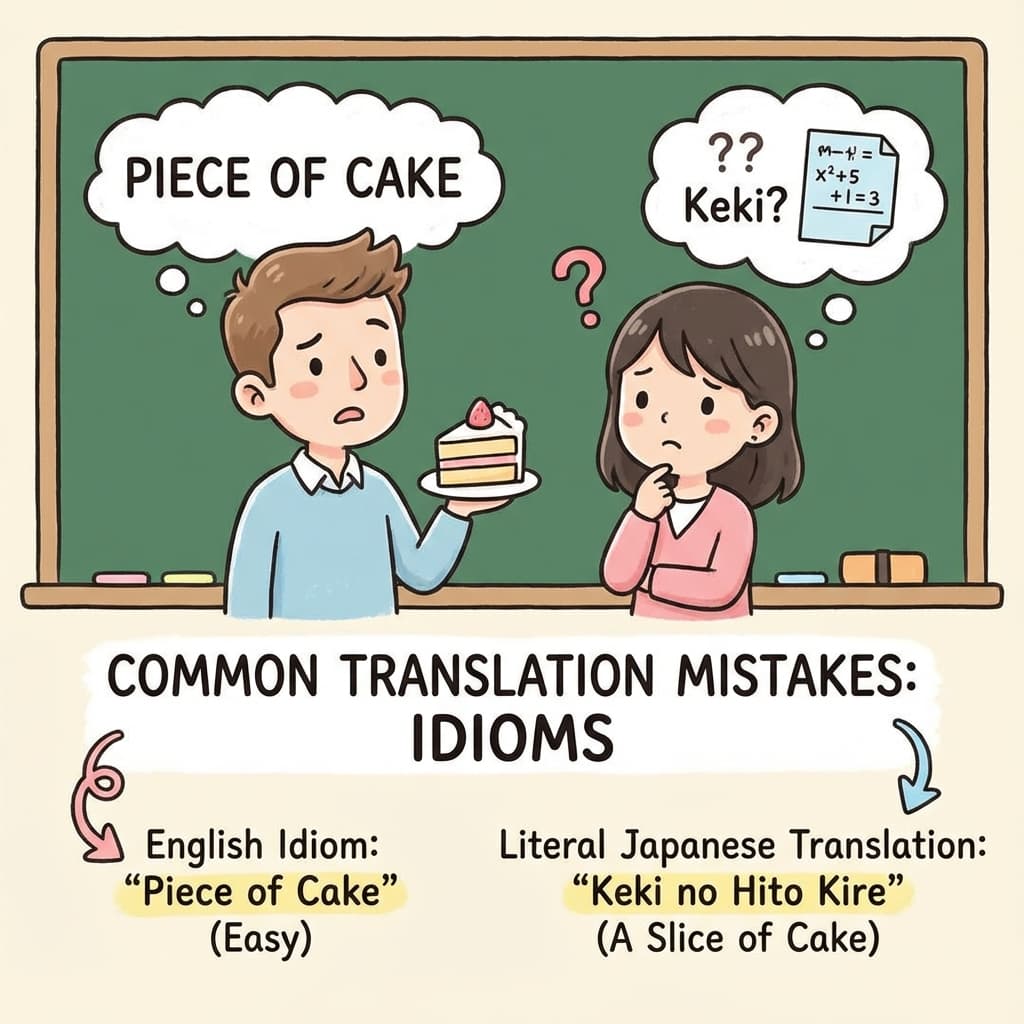
2. Direct Translation of Idioms
English is full of colorful idioms that make zero sense when translated literally.
Examples of Failures:
- "Piece of cake"
- Literal: "Keiki no hitokire."
- Japanese Reaction: "Do you want cake?"
- Correct Japanese: "Asameshi mae" (Before breakfast) or simply "Kantan" (Easy).
- "Break a leg"
- Literal: "Ashi wo ore."
- Japanese Reaction: "Why do you want me to get hurt?!"
- Correct Japanese: "Ganbatte" (Do your best).
- "It's raining cats and dogs"
- Literal: "Neko to inu ga futteiru."
- Japanese Reaction: Horror.
- Correct Japanese: "Doshaburi" (Downpour).
The Fix: Never translate an idiom word-for-word. Look up the meaning and find the Japanese equivalent.
3. Ignoring Politeness Levels (Keigo)
English has one level of politeness: "Please." Japanese has three main tiers, and mixing them up is a recipe for disaster.
Tier 1: Casual (Tameguchi)
- Used with: Friends, family, children, people younger/lower rank than you.
- Verb Ending: Dictionary form (Iku, Taberu).
- Risk: If used with a boss or stranger, you sound rude and uneducated.
Tier 2: Polite (Teineigo)
- Used with: Strangers, acquaintances, colleagues.
- Verb Ending: -Masu / -Desu (Ikimasu, Tabemasu).
- Risk: Safe for almost all situations. When in doubt, use this.
Tier 3: Honorific/Humble (Keigo)
- Used with: Customers, clients, superiors, elders.
- Structure: Completely different verbs.
- To Eat: Meshiagaru (Honorific), Itadaku (Humble).
- To Go: Irassharu (Honorific), Mairu (Humble).
- Risk: If you don't use this with a client, you might lose the contract. If you use it with a friend, you sound sarcastic or distant.
4. Gendered Speech (Yakuwarigo)
Japanese "Role Language" means men and women often use different sentence endings and pronouns.
Pronouns (I)
- Watashi: Gender-neutral, polite. Safe for everyone.
- Boku: Soft masculine. Used by boys and men.
- Ore: Strong masculine. Rough, casual. Never use in business.
- Atashi: Feminine. Casual.
Sentence Endings
- -Wa: Feminine softening. "Kirei da wa" (It's beautiful).
- -Kashira: Feminine "I wonder."
- -Ze / -Zo: Masculine emphasis. "Iku ze!" (Let's go!).
The Mistake: Learning Japanese from anime often leads to men using "Atashi" (sounding like a teenage girl) or women using "Ore" (sounding like a yakuza gangster).
The Fix: Stick to "Watashi" and "Desu/Masu" until you are advanced enough to understand the nuance.
5. The "No" Problem
In English, we say "No." In Japanese, saying "Iie" (No) to a request is considered too blunt and hurtful.
The Scenario: Someone invites you to dinner, but you can't go.
- English: "No, I can't go."
- Bad Japanese: "Iie, ikemasen." (No, I cannot go.)
- Natural Japanese: "Chotto..." (A little bit...)
The Fix: Japanese people trail off. "Kyou wa chotto..." (Today is a little bit [difficult]). The listener fills in the blank and understands it's a no. It saves face for everyone.
👉 Translation Guide: Japanese to English Translation Tips
6. Over-Subjecting (Watashi wa... Watashi wa...)
In English, every sentence needs a subject.
- "I went to the store. I bought milk. Then I came home."
In Japanese, once the topic is established, you drop it.
- Bad Japanese: "Watashi wa suupa ni ikimashita. Watashi wa gyuunyuu wo kaimashita. Watashi wa kaerimashita."
- Natural Japanese: "Suupa ni itte, gyuunyuu wo katte, kaerimashita." (Went to store, bought milk, returned.)
The Fix: If you start every sentence with "Watashi wa," you sound incredibly self-centered and repetitive. Trust the context.
7. Loan Words (Katakana) False Friends
Just because a word sounds English doesn't mean it is.
- Arubaito (Baito): From German "Arbeit." Means part-time job.
- Pasokon: Personal Computer.
- Konbini: Convenience Store.
- Saabisu (Service): Often means "Free of charge" (on the house), not just customer service.
- Tenshon (Tension): Means "Excitement/Energy" (High tension = Hyper), not stress/conflict.
Conclusion
Translating English to Japanese is about more than vocabulary; it's about empathy. You have to understand who you are talking to, what your relationship is, and how to maintain social harmony.
Summary Checklist:
- Stop saying "Anata." Use names.
- Don't translate idioms literally.
- Match your politeness level to the situation.
- Watch your gendered pronouns.
- Soften your "No."
- Drop the "I."
Master these, and you will stop sounding like a translation bot and start sounding like a person.
Expert writer on Japanese culture and anime trends.