What is Japanese Time Now? The Ultimate Guide to JST and Punctuality
Table of Contents
Planning a call to Tokyo? Find out what is Japanese time now, understand the lack of Daylight Saving, and master the strict culture of punctuality.
Mike Ross
Verified ExpertJapanese Language Specialist (JLPT N2) | Manga Critic since 2018 | 10,000+ Translations Reviewed
Published: 2025-11-20
View Credentials & Review Process →If you are working with a Japanese team or planning a Skype date with a friend in Tokyo, the first question is always: "What is Japanese time now?"
But knowing the hour is only half the battle. You also need to understand the concept of time in Japan, which is arguably the most punctual society on Earth.
Part 1: The Basics of JST
Japan uses Japan Standard Time (JST).
- UTC Offset: UTC+9
- Time Zones: The entire country, from the snowy north of Hokkaido to the tropical islands of Okinawa, is in the same time zone. No confusion.
Quick Conversions (Standard Time)
- London (GMT): Japan is +9 hours ahead. (8 AM London = 5 PM Tokyo)
- New York (EST): Japan is +14 hours ahead. (7 PM New York = 9 AM Tokyo next day)
- Los Angeles (PST): Japan is +17 hours ahead. (4 PM LA = 9 AM Tokyo next day)
- Sydney (AEST): Japan is -1 hour behind. (10 AM Sydney = 9 AM Tokyo)
👉 Business Tips: Japanese Business Etiquette: A Survival Guide
Part 2: The Daylight Saving Trap
Here is where everyone gets confused. Japan does NOT observe Daylight Saving Time (DST).
- Summer: When the US/UK "spring forward," the time difference with Japan decreases by 1 hour.
- Winter: When the US/UK "fall back," the time difference increases by 1 hour.
Why no DST? The US Occupation forces introduced DST in 1948, but it was unpopular (farmers complained it messed up their schedules) and was abolished in 1952. It has never returned.
👉 Business Tips: Japanese Business Etiquette: A Survival Guide
Part 3: The Culture of Punctuality
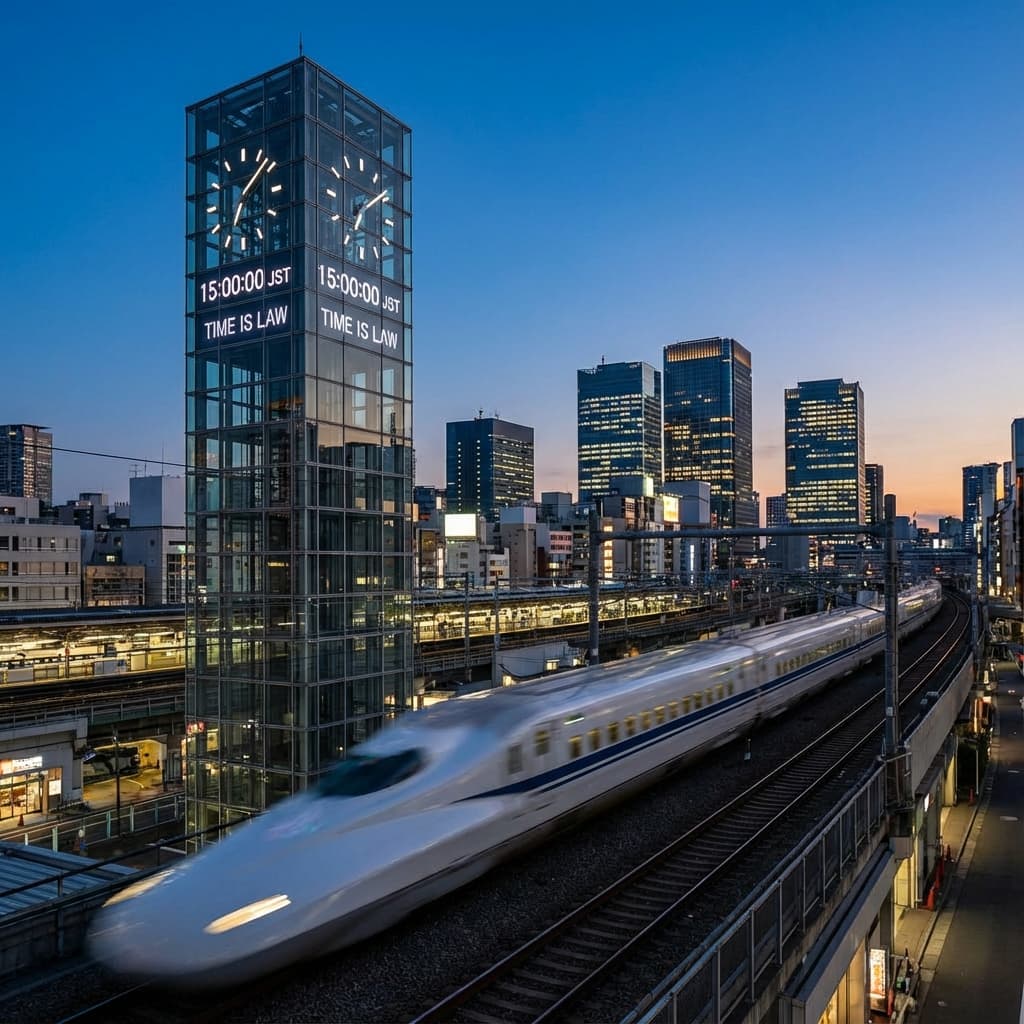
In Japan, time is not a guideline; it is a law.
1. Trains Run to the Second
If a train is scheduled to arrive at 8:42:00, it arrives at 8:42:00.
- The Apology: If a train is delayed by even 1 minute, the conductor will apologize over the intercom.
- The Certificate: If a train is delayed by 5 minutes or more, the station staff will issue "Delay Certificates" (Chien Shoumeisho) for passengers to show their bosses to prove it wasn't their fault they were late.
2. The "5 Minutes Early" Rule (5-fun mae koudou)
In business and school, "On time" means "Late."
- The Rule: You should be at the meeting location, ready to start, 5 minutes before the scheduled time.
- Example: If a meeting is at 10:00 AM, arriving at 10:00 AM is frowned upon because you still need to sit down, open your laptop, and get water. You should be seated by 9:55 AM.
3. Business Hours
- Standard: 9:00 AM to 6:00 PM.
- Overtime (Zangyou): Japan is famous for long working hours. Calling a business partner at 7:00 PM or 8:00 PM is often still acceptable (though not always appreciated!).
Part 4: Writing Dates and Times
When booking hotels or reading schedules, format matters.
- Date Order: Year / Month / Day
- Example: 2025年11月28日 (2025-11-28)
- Time Format: The 24-hour clock is standard in writing.
- Example: 18:00 (6:00 PM).
- Note: You might see "25:00" or "26:00" on TV schedules or bar signs. This means 1:00 AM or 2:00 AM the next day, implying the "business day" hasn't ended yet.
Part 5: Seasonal Differences
Because Japan doesn't use DST, the sunrise times can feel extreme to Westerners.
- Summer (June): Sunrise in Tokyo is around 4:25 AM. It gets bright very early! Sunset is around 7:00 PM.
- Winter (December): Sunset is around 4:30 PM. It gets dark very early.
Conclusion
When asking "what is Japanese time now," remember that you are tapping into a culture that values precision. Set your watch, double-check the Daylight Saving difference, and whatever you do—don't be late!
Expert writer on Japanese culture and anime trends.