How to Say Hello in Japanese: The Complete Guide to Greetings
Table of Contents
Master the art of Japanese greetings. From "Konnichiwa" to business etiquette and casual slang, learn how to say hello in Japanese like a local.
Yumi Tanaka
Verified ExpertJapanese Language Specialist (JLPT N2) | Manga Critic since 2018 | 10,000+ Translations Reviewed
Published: 2025-11-23
View Credentials & Review Process →One of the first phrases anyone learns is "Konnichiwa." But if you walk around Tokyo saying "Konnichiwa" to everyone you meet, you might get some strange looks. Why? Because in Japanese culture, how to say hello depends entirely on who you are talking to, when you are talking to them, and the context of the situation.
This guide will take you beyond the textbook basics and teach you the nuances of Japanese greetings, ensuring you always make a great first impression.
Part 1: The Big Three (Time-Based Greetings)
Unlike English, where "Hello" works 24/7, Japanese greetings are strictly tied to the clock.
1. Ohayou Gozaimasu (Good Morning)
- Pronunciation: Oh-hah-yoh Go-zai-mas
- Time: From waking up until about 10:30 AM or 11:00 AM.
- Usage:
- Formal: "Ohayou Gozaimasu" (To bosses, strangers, elders).
- Casual: "Ohayou" (To family, friends, classmates).
- Cultural Note: In some workplaces (like TV stations or restaurants), staff say "Ohayou Gozaimasu" no matter what time they arrive, as it marks the "start" of their work day.
2. Konnichiwa (Good Afternoon / Hello)
- Pronunciation: Kon-nee-chee-wah
- Time: From 11:00 AM until sunset (around 5:00 PM or 6:00 PM).
- Usage: This is the standard "Hello." It is semi-formal.
- Nuance: Interestingly, close friends often don't say "Konnichiwa." It can sound a bit stiff. They might just say "Yah" or "Genki?" (How are you?).
- Kanji Fact: It literally means "As for today..." (Konnichi wa...).
3. Konbanwa (Good Evening)
- Pronunciation: Kon-ban-wah
- Time: After sunset / dark.
- Usage: Used when meeting someone in the evening. Like Konnichiwa, it is semi-formal.
👉 Vocabulary: Japanese Culture in Japanese: Key Vocabulary
Part 2: The Art of Bowing (Ojigi)
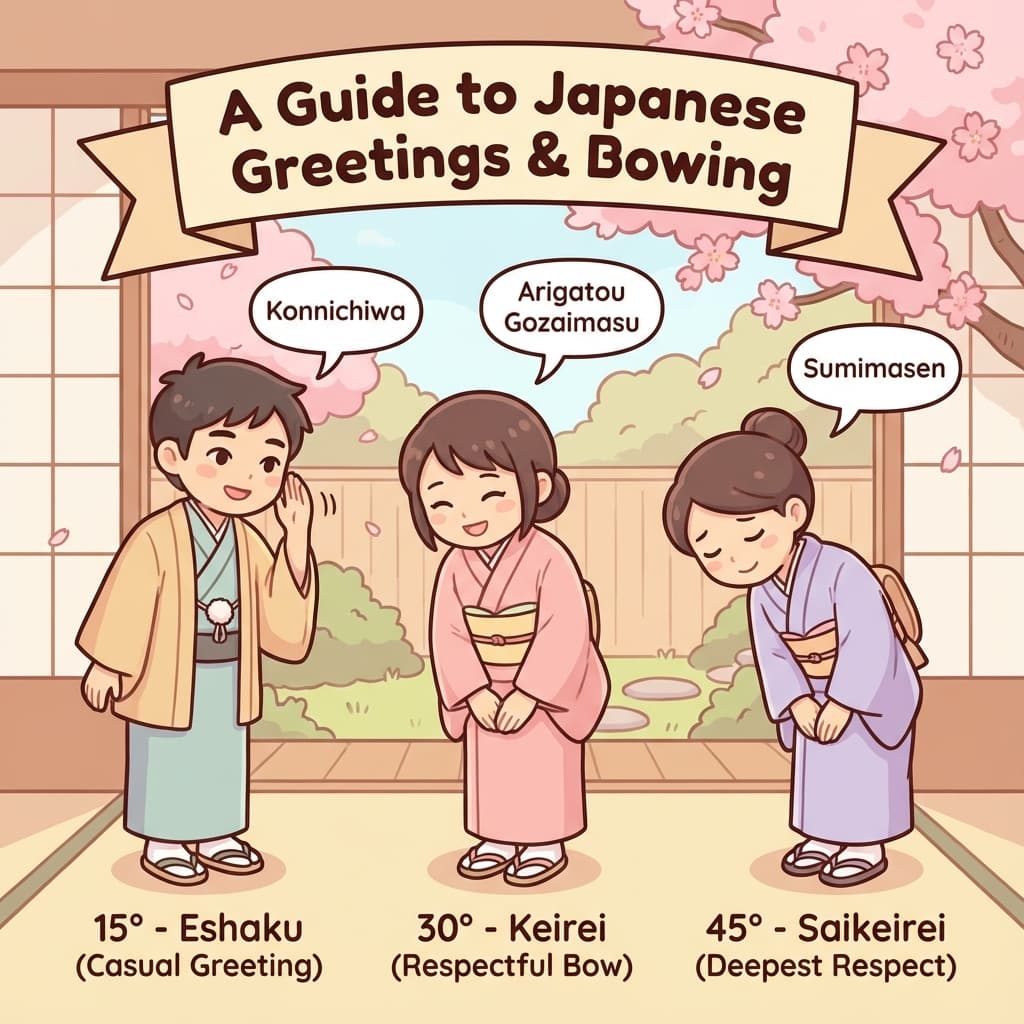
You cannot separate the greeting from the bow. In Japan, words are often accompanied by a physical gesture of respect.
- The Eshaku (15°): A quick nod/bow. Used when passing a coworker in the hall or greeting a convenience store clerk.
- The Keirei (30°): The standard business bow. Used when meeting a client or entering a meeting room.
- The Saikeirei (45°): The deep bow. Used for sincere apologies or deep gratitude.
Pro Tip: Men bow with hands at their sides. Women bow with hands clasped in front. And never bow while walking; stop, bow, then continue.
👉 Vocabulary: Japanese Culture in Japanese: Key Vocabulary
Part 3: Business and Formal Greetings
In a business setting, "Konnichiwa" is often too casual.
1. Osewa ni natte orimasu
- Meaning: "Thank you for your continued support/care."
- Usage: This is the standard opening phrase for business emails and phone calls to clients. It acknowledges the relationship.
2. Otsukaresama desu
- Meaning: "Thank you for your hard work."
- Usage: The ultimate workplace greeting. You say it to coworkers when you pass them in the hall, when you start a meeting, or when someone leaves. It acknowledges their effort.
- Morning: "Ohayou gozaimasu."
- During work: "Otsukaresama desu."
- Leaving: "Osaki ni shitsurei shimasu" (Excuse me for leaving first).
Part 4: Casual and Slang Greetings
When hanging out with friends, you can drop the formality.
- Yah / Yo (やぁ / よ): "Hey." Mostly used by guys.
- Ossu (おっす): "Hey/Sup." Very masculine, often used in sports circles or martial arts. It's a contraction of "Ohayou Gozaimasu."
- Hisashiburi (久しぶり): "Long time no see."
- Formal: "O-hisashiburi desu."
- Casual: "Hisashiburi!"
- Genki? (元気?): "How are you?" / "You good?"
- Answer: "Genki!" (I'm good!).
Part 5: Scenario-Specific Greetings
1. Answering the Phone
- Phrase: "Moshi Moshi"
- Usage: Only on the phone! Never say this to someone's face. It comes from the verb "Mousu" (to speak/say).
- Business Phone: In business, you don't say Moshi Moshi. You say "Hai, [Company Name] desu."
2. Entering a Store
- Phrase: "Irasshaimase!"
- Meaning: "Welcome!"
- Response: You do not need to say it back. You don't even need to say hello. A silent nod or a small smile is perfectly polite.
3. Visiting a Home
- Phrase: "Ojama shimasu"
- Meaning: "I am disturbing you" (literally).
- Usage: Said when you step into someone's Genkan (entryway). It shows you respect their private space.
4. Goodbye
- Sayonara: The most famous Japanese goodbye, but be careful! It implies a long separation or a final goodbye (like breaking up).
- Mata ne / Jaa ne: "See you later." The standard casual goodbye.
- Shitsurei shimasu: "Excuse me." The standard formal/business goodbye.
Conclusion
Learning how to say hello in Japanese is about reading the air (Kuuki wo yomu). Are you speaking to a superior? Is it morning or night? Is it a close friend?
By choosing the right greeting, you do more than just say "hi"—you signal that you respect the other person and understand their culture. So next time, try swapping that "Konnichiwa" for a hearty "Ohayou Gozaimasu" or a polite "Otsukaresama desu" and watch the smiles you get in return.
Expert writer on Japanese culture and anime trends.